Garment Production in China: Four Checks Before You Ship
We cut a hole in your sample first
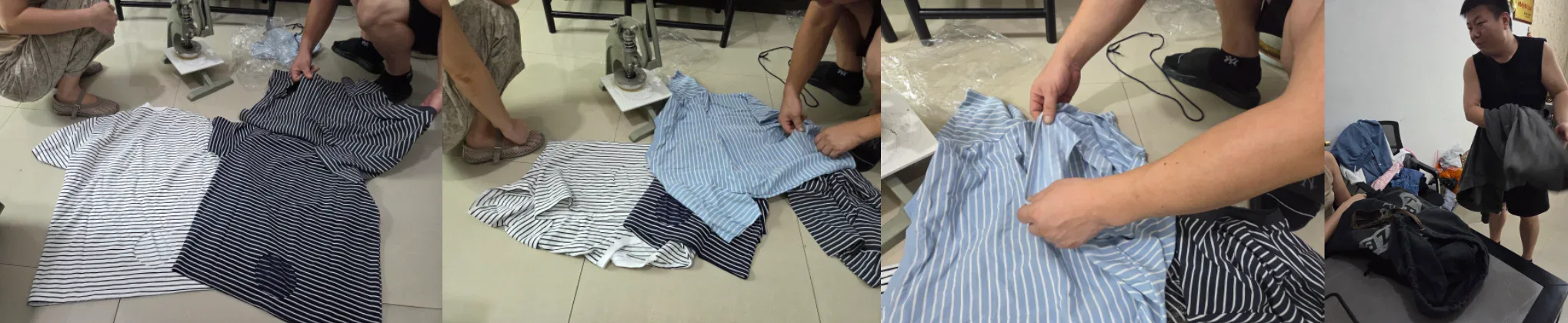
The reference sample goes on the floor and we go through it with the factory manager. In the middle frame you can see a small hole in the garment. We made it. Many of these samples started as something a buyer picked up from a booth in Yiwu Market.
Why composition testing comes before pricing
We cut a piece of the fabric and send it for composition testing. How much cotton, how much polyester, is there spandex, what is the knit structure. You can look at a fabric and feel it and make a good guess, but a guess ruins two things.
The price. Fabric is the largest single cost in a garment. If you do not know the composition, your quote is an estimate, and an estimate always gets corrected later. That correction arrives after the customer has already approved the price.
The fabric sourcing. There are dozens of fabrics that look alike. You need the exact composition and knit to find the right one. Otherwise you get something close, and something close looks different once it is in bulk.
Cutting one hole saves days later.
When the fabric arrives, the fabric gets checked too
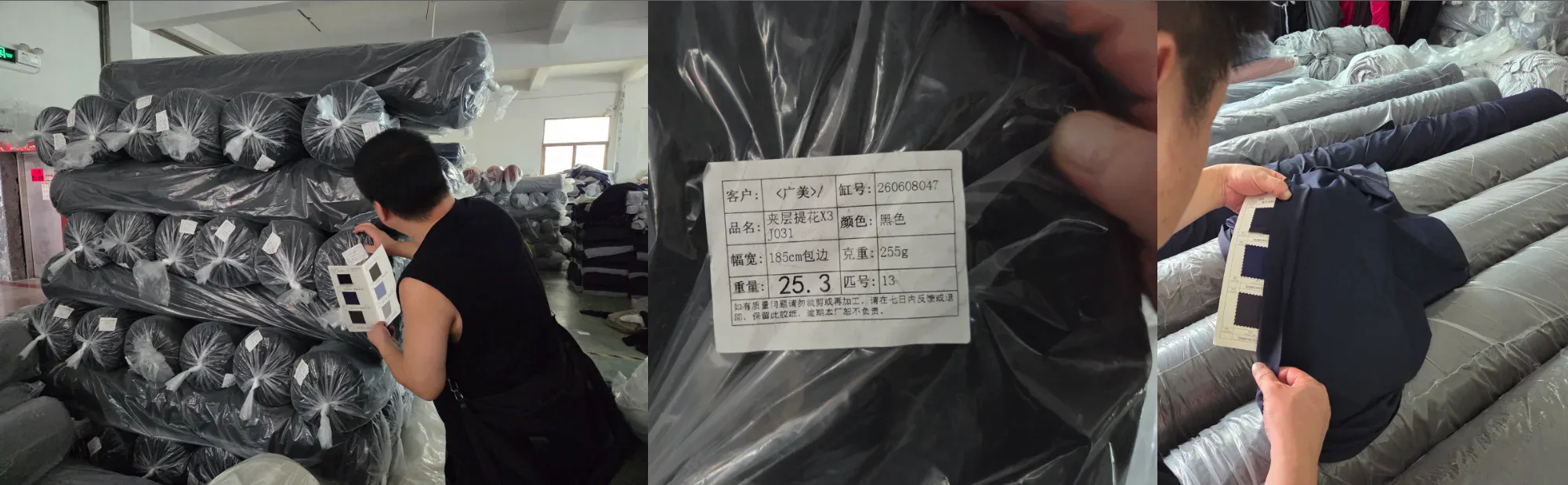
On the left is the fabric store at the factory. These rolls are your order. The other frames show the fabric being checked against the approved color swatch. This happens before anything is cut.
Fabric has defects too. A fabric problem found after sewing is not a problem, it is a remake.
What we look for in fabric
- Color. Checked against the approved lab dip. Rolls can differ from each other, and the edge of a roll can differ from the center.
- Contamination. Oil marks, stains, water damage. Common on fabric that has been sitting in a store room.
- Damage. Holes, tears, pulled threads, snags.
- Knit faults. Lines, uneven gauge, misaligned patterns.
- Width and weight. Narrow width kills your marker efficiency and you run short of fabric. Light weight gives you a different garment.
- Shrinkage. We wash test it. Skip this and the size problem is discovered by your customer.
The industry has a standard method for this called the four-point system. But the method is not the point. The point is whether somebody actually unrolled these before the cutting table started.
I go to the factory during production, not after it
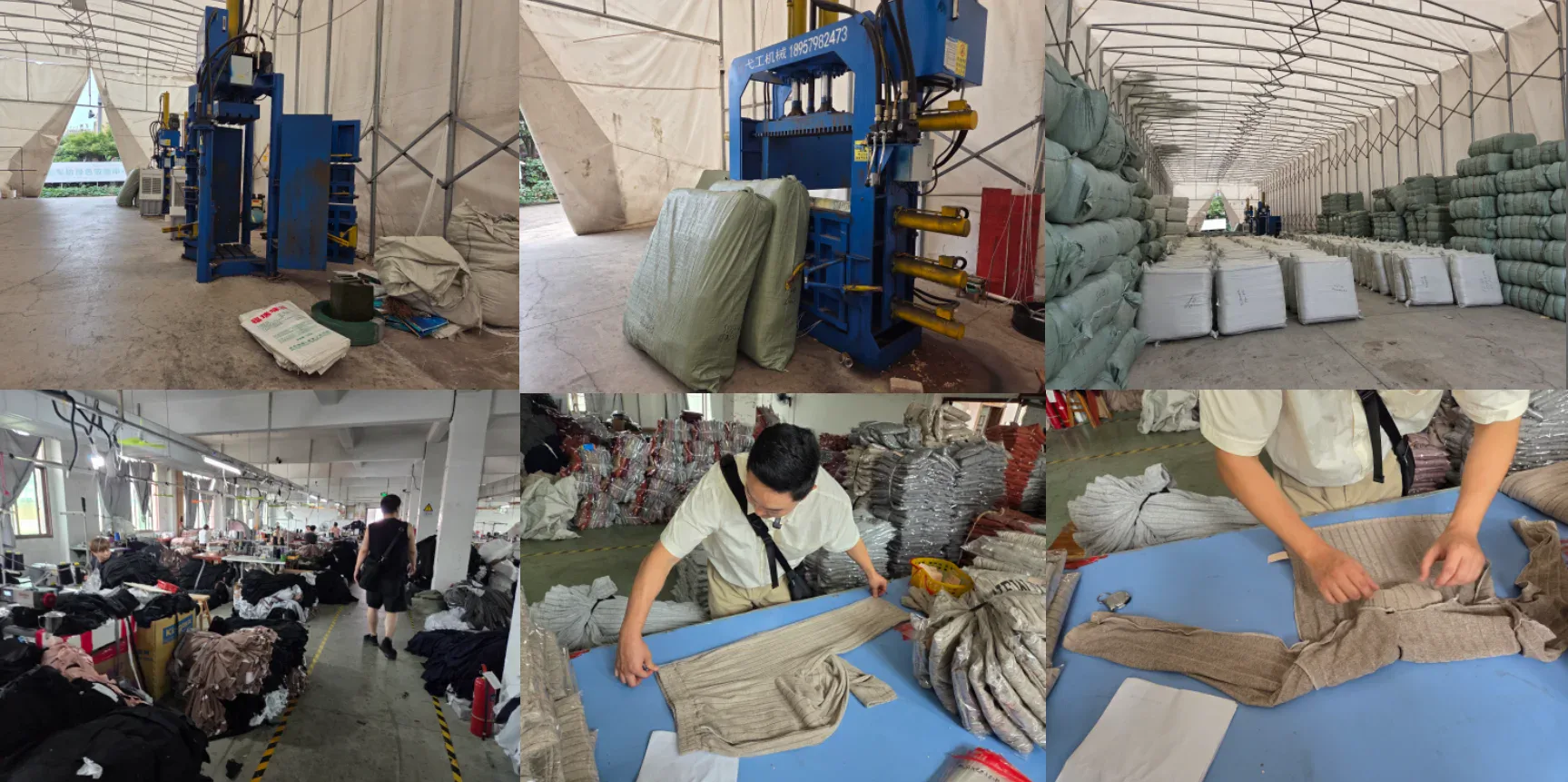
The sewing line, in-line inspection, the hydraulic press, and finished bales waiting to ship. This is the last stretch an order passes through.
Final inspection happens in our own warehouse in Yiwu, piece by piece. That part is fixed. But if the warehouse is where you first find the problem, ...you found it too late. So we go into the factory while production is running.
And if nobody is doing this at all, the problem surfaces at your end instead. That is the real risk in ordering from a listing.
What an early defect tells you
If a defect shows up at a mid-production check, that same defect is usually what shows up at final inspection. Defects are not scattered at random. They repeat, from one operation, one operator, one pattern piece.
So catching one in the middle is not fixing one garment. It is stopping the next several hundred.
Small defects and large defects are not the same problem
Small numbers of defects. These get fixed quickly. The delivery date does not move.
Large numbers of defects, or a pattern that is simply wrong. This is different. Reworking takes real time, and that time comes straight out of the production schedule. This is where most missed deadlines come from.
Clothing is seasonal, which raises the stakes
A summer garment that arrives late is not just late. It cannot be sold until next season. That pressure does not exist for most other products, and it is why we go back into the factory more than once during a run.
Compression packing, and why volume is money
The two frames on the right of the photo above are a compression packing warehouse. Wholesale buyers moving large volumes prefer this method. Those bales all ship in two days.
Here is a full container going out, from the same warehouse.
How much more fits
Clothing is mostly air. A hydraulic press squeezes that air out and cuts the volume by roughly half to two thirds. In practical terms, you fit about 2 to 2.5 times more in the same space.
The exact figure depends on the garment and the press. Heavy knits compress more than thin shirts.
One thing to know before you choose it
Compressed cargo often hits the weight limit before it hits the volume limit. The harder you compress, the more your constraint becomes container weight rather than container space. New buyers miss this. You end up with space left over that you cannot legally fill.
Calculate volume and weight together before you decide on compression.
Frequently asked questions
Why test the composition of a sample?
To price it correctly and to source the right fabric. Without the composition, the quote is a guess and the fabric will be a near match rather than a match.
Should fabric be inspected before cutting?
Yes. A fabric defect found after sewing is a remake, not a repair.
Why visit the factory during production?
Because defects repeat. Catching one in the middle stops the next several hundred. And large problems take real time to rework, which directly threatens the delivery date.
How much more fits with compression packing?
Roughly 2 to 2.5 times, because the volume drops by about half to two thirds. Be aware that compressed cargo often reaches the container weight limit before the volume limit.
Where does final inspection happen?
In our own warehouse in Yiwu, piece by piece. The mid-production checks at the factory do not replace it. They reduce what reaches the warehouse as a problem.
If you are planning production
I am based in Yiwu. I source fabric, manage production at factories here, and ship finished goods to buyers in Korea, the United States and Europe. The photos above are from an ordinary working day. If you want to see how an order gets managed, you can reach me here.
